World Map Quiz
- 4.8
- Rating
- 5.00M
- Installs
- Free
- Price

 Analysis by App-foxy
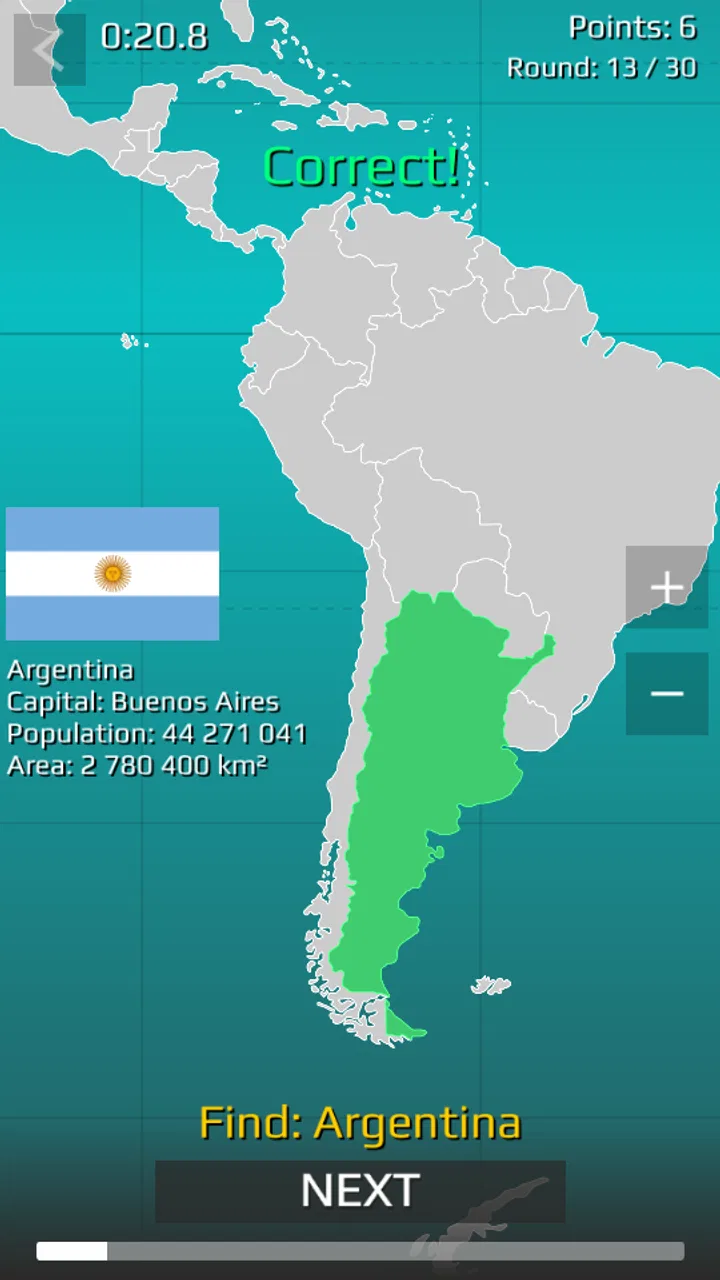
World Map Quiz is the sort of trivia game I open when I want something light but still useful. Instead of asking for capitals, flags, or historical facts, it focuses on the physical locations of countries, turning geography into a visual memory challenge. I found that simple idea more demanding than it first appears: recognizing a country is one thing, but placing it correctly among neighboring shapes is another.
Developed by Qbis Studio, this free game belongs to the trivia category and is rated for Everyone. It has built a substantial audience, with an average rating of 4.8 from around 61 thousand ratings and more than 5 million installs. Those figures suggest a mature, widely used title rather than a newly released experiment, and my experience fits that impression. The presentation is focused and practical, with the map itself doing most of the work instead of being buried under unnecessary decoration.
How the current version feels to play
The central appeal is easy to understand. You are shown a world map and asked to identify where a country belongs. That makes each round a mixture of recognition, deduction, and memory. When I know the region, I can often narrow the answer by coastline, neighboring countries, or overall shape. When I do not know it, the game exposes exactly how weak my mental map is.
You May Also Like

 Blood Strike: 2.5 Anniversary
Blood Strike’s Loadouts Turn Every Drop Into a Tactical Gamble
A close look at Blood Strike’s custom loadouts: how fast access to signature weapons reshapes its battle royale rhythm, rewards preparation, and narrows the gap between fights.

 Pandora - Music & Podcasts
Pandora’s Music Is Easy to Start, but Harder to Recover
Pandora’s strength is its low-effort path from a seed to a station. Its weak spot is how much confidence it asks you to place in connection, setup, and quiet recovery.

 8 Ball Pool
 Is Built on Rivalries, Rematches, and Routine
A close look at the rivalries, rematches, shared routines, and unanswered safety questions that turn a quick pool match into a persistent mobile community.

 Samsung Music
’s Quiet Strength Is Playing What You Already Own
Its reach comes less from spectacle than from dependable access to a personal library. That simplicity is both the app’s strongest retention engine and its ceiling.

 AccuWeather: Weather Radar
AccuWeather Review: A Quick, Clear Forecast for Everyday Decisions
For everyday plans, the best forecast is the one you can understand quickly. AccuWeather makes rain timing, radar, and local conditions easy to act on, with a few trade-offs.

 Hill Climb Racing
Why Hill Climb Racing Still Turns Crashes Into One More Run
A tiny car, a bumpy hill and one more upgrade: Hill Climb Racing keeps resurfacing because its simple chaos makes every near-miss feel personal.
More From Our News Desk



That learning loop is the strongest part of the experience. A wrong answer does not feel entirely wasted because it gives me a visual association to remember. Countries that previously seemed like disconnected names start to acquire a place in relation to one another. I began thinking in clusters rather than isolated facts: the countries around a sea, a chain of states across a continent, or a small nation tucked between larger neighbors.
The current release is version 3.34.2, and the product feels like something that has had time to settle into its purpose. It was released on July 22, 2015, so it is not trying to win attention through novelty alone. Its value comes from repeatable practice. I can play for a short session, stop, and return later without having to remember a complicated story, a large inventory, or a long-term progression system.
That simplicity also makes it approachable for families and classrooms. A child who enjoys quizzes can use it as a gentle introduction to geography, while an adult can treat it as a personal challenge to repair gaps in general knowledge. The Everyone rating supports that broad audience, though younger players may still benefit from playing with someone who can explain why a location matters rather than simply celebrating a correct tap.
A useful routine for learning rather than guessing
I get more from the game when I resist the urge to tap quickly. My first instinct in trivia games is often to choose the answer that looks familiar, but map questions reward a slower scan. I look at the continent, identify the nearest coastline or border, and then compare the available shapes. This turns each question into a small reasoning exercise instead of a memory lottery.
A particularly effective routine is to pause after an incorrect answer and describe the location aloud in ordinary language. I might say that a country is north of another one, lies along a particular coast, or sits between two familiar neighbors. That extra sentence creates a stronger memory than simply seeing the correct position flash by. The game provides the prompt, but the learning improves when I add my own explanation.
I also prefer short, repeated sessions to one long attempt. Geography fatigue arrives quietly: after too many rounds, I start choosing based on shape alone and stop checking regional context. A few minutes at a time keeps the challenge useful. This is one of the less obvious strengths of a focused map quiz: it works well as a waiting-room activity, a quick break, or a warm-up before studying, because it does not demand a large block of attention.
Another practical use is preparing for travel or schoolwork. I would not rely on it as a complete geography course, but it can help build a basic spatial framework before reading about a region. Once the map locations feel familiar, names in articles and lessons become easier to place. That is more valuable than memorizing a list because the knowledge has a visual structure.
What the long development tells me
The long life of this game matters because map trivia can become frustrating if its content or interaction feels rough. The current version number indicates ongoing product development, but I would separate that evidence from assumptions about major redesigns. A version update does not automatically mean a new learning system or a dramatic visual overhaul. What I can say from using the current release is that the core idea remains clear and usable.
That continuity is good news for returning players. Someone who enjoyed the game years ago can come back to the same basic kind of challenge without having to relearn an entirely different product. It also means the game knows what it wants to be. Many trivia apps expand into unrelated categories, social features, or complicated reward structures. This one stays centered on world geography, which gives its practice a more coherent feel.
At the same time, a mature design can feel conservative. Players looking for constant novelty may find the basic question format repetitive after the initial excitement fades. The game’s strength is reinforcement, not surprise. I see that as a deliberate trade-off: it is better suited to building familiarity than to delivering a different spectacle every time I open it.
The free entry point is another important part of its current state. I can try the main experience without paying upfront, while in-app purchases range from $1.99 to $12.99 per item. That makes the decision relatively easy for a curious player: install it, test whether map-based trivia is enjoyable, and decide later whether any paid option is worthwhile. I would still check the purchase screen carefully before confirming anything, especially if a child is using the device.
Where it fits among other geography games
World Map Quiz occupies a different space from a flag quiz. Flags test visual symbols, while this game tests spatial relationships. A player may know a country’s flag immediately and still struggle to place it on a map. Conversely, someone who remembers continental layouts may perform well here without knowing many national emblems.
It is also different from a capitals-focused trivia app. Capital questions reward factual recall, but map placement gives me a more connected understanding of the world. I can see why a country matters geographically even when I cannot recall its capital. If my goal is exam preparation specifically centered on capitals, another app may be more efficient. If my goal is to stop treating countries as names floating without context, this is the better fit.
Compared with a full educational atlas, the game is faster and more motivating, but much less comprehensive. An atlas can explain borders, regions, physical geography, and historical context. This quiz cannot replace that depth. Its role is closer to active recall: it makes me retrieve a location, exposes uncertainty, and encourages another attempt. I would use it alongside reading or lessons, not as my only source of geographic knowledge.
It also compares favorably with passive map browsing when I need a reason to pay attention. Looking at a map can be relaxing, but it is easy to scan without retaining much. A quiz creates a small consequence for not knowing, which makes me inspect the map more carefully. The trade-off is that the game may simplify a complicated subject into fixed answers, while real borders and regional identities can involve more nuance than a tap-based question suggests.
Who will enjoy it, and who may lose interest
I would recommend it to casual learners, parents looking for a low-pressure educational game, students who need more visual geography practice, and trivia fans who enjoy improving through repetition. It is particularly good for people who say, “I know the name, but I could not point to it.” That sentence describes the exact gap this game helps address.
It is less suitable for someone who wants a rich simulation, a narrative campaign, or a highly social competition. The appeal depends on caring about locations and being willing to meet the same kind of challenge repeatedly. If I want rapid-fire variety across science, entertainment, history, and sports, a broad trivia platform will probably feel more rewarding.
Players with strong geography knowledge may also reach a plateau. Once the common locations become automatic, the experience can shift from discovery to score improvement. That is not necessarily a flaw, but it changes the reason to continue. I keep it installed because occasional review is useful, while a dedicated geography expert may prefer a more advanced tool with detailed regional information or harder specialist questions.
Small frictions that affect the experience
The focused format can become predictable. The same mental process—inspect the map, select a country, learn from the result—does not provide endless variety by itself. I would have liked more ways to use the knowledge after identifying a location, such as connecting it to nearby countries or explaining a regional pattern, but I do not treat that expectation as a promise of the game. The current experience is intentionally narrower.
There is also a difference between recognizing a shape and understanding a place. A player can improve at selecting the correct position without learning anything about culture, history, language, or physical geography. I found it helpful to use each question as a starting point for a quick follow-up search or conversation. Without that extra step, the game remains useful but limited to spatial recall.
Accuracy-minded users should keep the quiz’s simplified format in perspective. Maps are representations, and country borders can carry political and historical complexity. A trivia game needs clear answers, so it naturally reduces that complexity to a location on a screen. That is appropriate for practice, but I would not use a single quiz result as the final authority for a sensitive geographic question.
The free model is convenient, but in-app purchases mean that the overall experience may include optional spending decisions. Since individual items are listed between $1.99 and $12.99, I would enable purchase controls on a shared family device and make sure younger players understand that free installation does not mean every optional item is free. This is ordinary advice, but it matters more in a game designed for an Everyone audience.
How I would use it day to day
My favorite scenario is a short session during a commute or while waiting for an appointment. I start with the intention of playing only a few questions, then use the mistakes as a mini revision list. Later that day, I try to recall the locations without opening a map. That two-stage process—recognition in the game, recall afterward—makes the activity more effective than simply chasing a perfect run.
For a family, I would turn the screen into a conversation rather than letting everyone silently guess. One person can choose the answer, while another explains the neighboring countries or points out the region on a larger map. This makes the game work for mixed abilities: a child can practice visual recognition, and an adult can add context without making the session feel like a lesson.
For a student, I would use it before studying a continent in detail. First, play until the broad layout feels less unfamiliar. Then read about the region and return to the quiz later. The game is most helpful at the beginning and end of that cycle: it prepares the mental map and then checks whether the locations stayed in memory. It is not a substitute for course material, but it can make that material easier to organize.
For a traveler, I would focus on the countries surrounding the destination rather than trying to master the entire world at once. Knowing the nearby layout can make news, transport discussions, and itinerary planning easier to follow. The game cannot provide current travel guidance, and I would never use it for border or visa decisions, but it can supply a useful geographic foundation.
What existing users should expect
Returning players should expect continuity more than reinvention. The current version, 3.34.2, represents an established release rather than a reason to assume that every older habit has been replaced. If I already enjoy the game, the main benefit of coming back is continued access to a compact geography practice tool. I would not install it expecting a completely different genre or a broad expansion into general trivia.
New users should give themselves permission to be bad at first. The game can expose gaps that are surprisingly basic, especially in regions I rarely read about. That initial discomfort is useful if I treat mistakes as a study guide. Trying to protect a score by guessing quickly is less valuable than noticing why a location surprised me.
The large audience and strong average rating make the game easier to recommend, but popularity does not remove the need to match it to the right goal. I would judge it by whether I want map practice, not by whether it can replace every other geography resource. Its best quality is focus, and focus always means leaving some needs to other tools.
What I would watch in future updates
If Qbis Studio continues developing the game, I would be most interested in improvements that deepen learning without making the interface complicated. Clearer ways to revisit mistakes, more deliberate regional practice, or explanations that connect a country to its neighbors would add lasting value. Those are the kinds of additions that could help experienced players continue learning rather than simply repeating familiar answers.
I would also watch how the balance between free play and optional purchases evolves. The current free model is a strong reason to try the game, while the listed purchase range makes it sensible to review any confirmation screen before buying. Keeping the first-time experience welcoming would matter, especially for families and students who want a straightforward educational activity.
My final view is positive but specific: this is a good choice when I want to strengthen my mental map of the world through quick, repeatable questions. Its real strength is turning vague geographic familiarity into active location memory. It is not a complete atlas, a broad trivia collection, or a substitute for serious study. Still, for a free Everyone-rated game from Qbis Studio that has remained available through years of development, it offers a clear purpose and enough practical value to keep returning to.
I would install it for a child curious about countries, a student who needs visual reinforcement, or a friend who knows world news but struggles to place nations on a map. I would skip it only if I wanted constant category changes, deep explanations, or a competitive multiplayer experience. For everyone else, especially casual learners, World Map Quiz is an easy recommendation: play briefly, slow down on mistakes, and use each answer as a reason to understand the surrounding map.
FAQs for World Map Quiz
01What is World Map Quiz and how does it work?
World Map Quiz is an educational app designed to help users learn geography through engaging quizzes. It features various levels where players must identify countries, capitals, and landmarks on an interactive map. The app provides hints and allows users to track their progress, making it a fun way to improve geographic knowledge.
02Is World Map Quiz suitable for children?
Yes, World Map Quiz is suitable for children and adults alike. It offers varying levels of difficulty, making it accessible for younger users while still challenging for older ones. The app is a great educational tool for children to learn geography in a fun and interactive way.
03Does World Map Quiz require an internet connection to play?
No, World Map Quiz does not require an internet connection to play. Once downloaded, all the maps and quizzes are available offline, allowing users to enjoy the game anytime and anywhere without needing to worry about connectivity issues.
04Are there in-app purchases in World Map Quiz?
World Map Quiz offers a free version with basic features. However, there are in-app purchases available that provide additional features such as more challenging quizzes, ad removal, and extra hints. These purchases enhance the user experience but are not necessary to enjoy the core functionalities of the app.
05How does World Map Quiz track progress and performance?
World Map Quiz tracks progress by recording scores for each quiz and level completed. It provides detailed statistics, such as accuracy and time taken, enabling users to monitor their improvement over time. This feature helps users identify areas where they need more practice, making the learning experience more effective.
Pros
- Engaging and educational gameplay.
- Wide range of countries to explore.
- Frequent updates with new features.
- User-friendly interface.
- Offline mode available.
Cons
- Limited language options.
- Some geographical errors.
- Occasional ads interrupt play.
- Lacks multiplayer mode.
- No hints for difficult levels.

World Map Quiz
Gallery